I got a little bit obsessed…

I was reading The Count of Monte Cristo, I got a little bit obsessed. It’s one of my all time favourite books, though I’d only read it once – now twice. I wasn’t just reading it this time, I’ve been also been studying it, and studying Alexandra Dumas, I even tracked down a copy of Michael Ross’ biography of Dumas, (which as it turns out it’s hard to find literature, in English, on Alexandra Dumas, plenty in French but my two years of studying Francais isn’t up to that task).

See I love Alexandra Dumas, based on just two works The Three Musketeers, (I’ve read all the stories), and the Count of Monte Cristo. I knew who he wrote other stuff, but I hadn’t realised how much other stuff – the guy was prolific, as well as truly fascinating character in his own right, as was his father. However, that’s a post for another day, a nice big long post. In fact, there’s likely to be several posts on the subjects of the Count of Monte Cristo and Alexandra Dumas. I turned a 50 hour read into a 100+ hour project of learning, so obviously I’m going to put you through at least some of that.

However, I’ve finally finished reading The Count of Monte Cristo, next up is The Black Count: Glory, revolution, betrayal and the real Count of Monte Cristo – which is about Alexandra Dumas father, for whom part of the Count of Monte Cristo is based on.

I’m also going to be reading something more modern The Long Way to a Small, Angry Planet: Wayfarers 1 , I’ve heard great reviews about this series and I’m only just getting round to starting it, it’s something to look forward to.

I’m looking for inspirations for my reads after this, so feel free to comment with some good suggestions – aside from erotica, I have no limitations on genre, or age.

What I Blog About

So, let me make something clear – I’m in no way a successful writer, I’m not published, I enjoy telling stories and one day I may hit upon something I’d want to publish, but my craft is no where near where I would want it to be for that. I am an aspiring writer, hence the title of this blog, Aspiring.org.

I also really appreciate, and like to look at other people’s stories, which is why I’ve been adding in stuff about story telling from other writer’s, and other media. Now reviewing, or essaying about these is relatively new to me, and I’m early into honing it as a skill. I will improve though. I don’t think I’m going to ever be up there with the YouTube channel Movies with Mikey, who I highly recommend:

I can aspire though, and that’s what I’m all about. I will still be doing posts on the craft of writing, as I work out my way to becoming a half decent writer.

This isn’t a movie blog, but…

So, at the moment I’m really excited by a couple of movies coming up, the first for literary reasons, and the second for reasons nothing to do with writing but another interest of mine, (and it’s an excuse to talk about a non-writing passion).

There are spoilers ahead for the Le Mans 66 and new Dune movie, I’m feeling passionate about both, so I’m not self censoring – so it’s hidden behind the cut.

Continue reading “This isn’t a movie blog, but…”

Story Telling… I Admire: Babylon 5

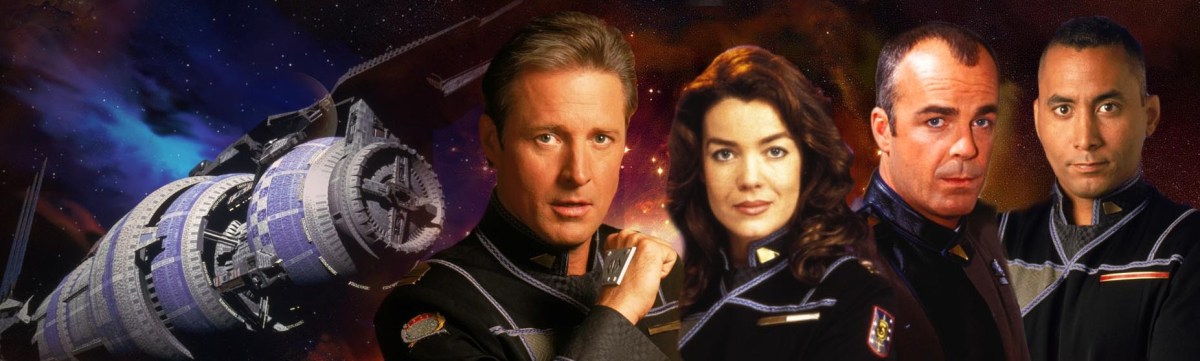
I’ve already mentioned how much I admire Dune, and aspire to that level of writing, so since I’m crap at reviewing, we’ll talk about what I admire about my favourites. Another one my all time favourites series, this time  a TV one, is Babylon 5, created by J. Michael Straczynski back in the 90’s.

So let’s talk about that.

A Bit of History (for those don’t remember the 90’s… which is increasingly more and more adults – darn time!)

Back in the 90’s, and in decades before that, the majority of television shows (though not all by far), were episodic, with arcs focused on that episode, and you could probably air many episodes out of order with little to no effect on the stories being told. Most of Star Trek is like this, and it’s fine – it’s what we expected, nay what we thought we wanted.

However J. Michael Straczynski while in the shower, combined two story ideas he’d been playing with a big space opera and a story taking place aboard a dinky little space station. The big space opera would be too big, and too expensive to make in a TV show, while an episodic TV show set aboard a space station wouldn’t have much life, just a few seasons. His eureka moment in the shower was that in combining the two, you could have a five year story that saw a universe at war, and peace, have politics and a consequences play out, and punctuate some action and fallout on the station to contextualise the space opera, without having to invest too significant parts of the budget for space battles.

They were doing this in the early days of the CGI revolution, now everyone with a some 3d program, and a video editing suite can put together a fleet on fleet battle, in HD or even 4k, with some time and patience.

Side note: I actually wonder if they could make Babylon 5 these days, the restrictions of budget and technology helped to create something amazing, but there aren’t the same limiting factors, you can do whole series in front of blue screens without much need for a set, you don’t need expensive physical models, and people are already trying to make CGI people a thing, so you might not need pricey actors either.

So, what is Babylon 5?

So back to the idea – a small contained space, operating as a space UN of sorts. It ties together smaller character driven stories and a grand epic. The factions have unique motivations to them which drive them, hurt them, and so on, and actions for against a faction has consequences for those factions and the over arcing plot.

I’m trying not to get into spoilers, but you have plots involving a character or characters place and interaction with their own state, you have law and order plots, including local (on the station), internal (with the one of the nations of the galaxy), and international, (with multiple nations involved), you have siege and attack plots, Revolutions, enslavement, spies, survivor stories, medical dramas, but also a sense of magical plots, magical tests and quests, mystical items, after life stuff, and I’m not so be with this yet, then you have interpersonal plots with romance, buddy cops, noir detectives, comedies, arguments and misunderstandings. Basically it has everything.

“But!” I hear you shoot, Star Trek has all of that – and you’re right, but except on DS9, it didn’t add to anything it was just adventure of the week.

Now DS9 was doing something similar, but it didn’t feel as in depth, it was more focused, where as Babylon 5 went in a hundred, but coherent, didn’t directions but brought it back together. What DS9 did do though was better communicate the world was ending and the war stories were just more intense, that’s where the budget differences came in I think. Babylon 5 was more cohesive, and the building blocks all lead to how it ends (taking season 4, not 5 in fairness).

So What Is It I Admire, And Can Learn

So ultimately what I admire is the ability to balance personal and grander story telling. Now it is probably easier in hundreds of 45 minute episodes than writing a novel, but when you look at each series, (1 through 4 anyway), they are beautifully balanced.

Where I fail is I get lost in scenes, specifically dialogue ones, I get stuck in circles, the dialogue in Babylon 5 is what carries the story, and it’s not as punchy as a Sorkin series, but still all the important dialogue is focused, and delivers three things each time, the characters personal feelings and motivations, exposition to explain the current situation, and the plan – what actions do the characters intend to do.

I like that, and I think ultimately that’s what I want to learn, and it doesn’t matter if it’s on screen or on a page I think it’s a good way to do dialogue. It will definitely help to have three things before writing dialogue scenes:

  • History
  • Motivation
  • Plan

Doesn’t matter what the plan is, it’s not the plot of the story, it’s just what the characters intend – actually that’s not true, it does matter, because for the dialogue to be important, whatever the characters decide will drive the plot, it’s just a matter of whether they succeed in their intentions, or are denied by another factor.

Also just to mention, as with Dune, I could go through a lot more, but I wanted to pick an element that is of particular interest to me right now.

Dune – A Tour De Force in Science Fiction

So my previous post was meant to go very differently, it was meant to go very differently, but I decided to focus on the conversion of stories across different mediums. So now we’re back again, and I’m going to see if I can say something intelligent and worthwhile about Dune. I honestly don’t think I can do it justice, but good news it’s my blog, and JL has thoughts to share in spades.

Be warned, spoilers ahead – I’ll make sure there’s a cut in before we get to anything too spoilery.

So…. Dune, the book series by Hugo and Nebula award winning Frank Herbert (Franklin Patrick Herbert Jr.), and it’s easily one of my favourites – I dare say the first book Dune is probably my favourite piece of fiction of all time,.

I still remember my dad giving me the book, I’d been ill, again I think (my memory isn’t always as reliable as I’d like it to be, unlike the Kwisatz Haderach in the story itself), I must have been eleven at the time. At eleven how much of it I could follow is probably debatable, but it’s such a rich story and world that as I grew my understanding and appreciation of it grew with me.

Without going into spoilers, Dune is a series book about the distant future of humanity as it’s spread among the stars. It features themes of survival, power, religion, ecology, economy and evolution, and collectively is a treatise on the human condition as interfaces with the world.

It’s probably the daddy of the epic science fiction, the first book being one of George Lucas’ inspirations for Star Wars. Before it, the idea of so deep a sci-fi story was  rarity. It’s scope is so massive, dealing with from tens of thousands of years into humanity’s future, and the series covers thousands of years from that point onward. The series covers a span of time nearly as great as recorded history today, and the time before the series begins isn’t just dead time, it has a whole back story that you learn as you read through, with many of the functions of future humanity coming about in the thousands of years preceding the books.

Unlike Star Wars, they’re not action orientated – there is some satisfying action in them, but it’s very tactical based, and fleeting, just to support the movement of the story. In fact, overall they’re some of the most dialogue laden stories out there.

So, in short if you like a detailed grand epic science fiction… there’s an awful lot to love. And if you want to go further than the original series Frank Herbert’s son Brian and Kevin J Anderson (who is a major contributor to the Star Wars universe), they’re a lot cleaner writing so easier to read, and some elements maybe didn’t need an explanation, but they do bring the whole thing together at the end and finish of the story in a way Frank Herbert wasn’t able to do before his death, and they do add to the grand richness of the universe created in Dune.

So much to love, the books can be hard to read at times, and you find yourself trying to hold on to factoids, stories,  and ideas as you’ll need them later for reference when something else happens. They’re not a casual reads, but well worth your time.

So that’s a general look at Dune… from here there may be spoilers – somethings I have in my mind to say just can’t avoid it. If you’ve not read the books  go check them out, Frank Herbert’s original series are also all available on Audible if you want an easier time (well read by Simon Vance, Euan Morton,  Orlaigh Cassidy and several others bring the books to life, and they’re unabridged.

Continue reading “Dune – A Tour De Force in Science Fiction”